

Why Your Estate Plan and Succession Plan Need to Work Together — Before It's Too Late
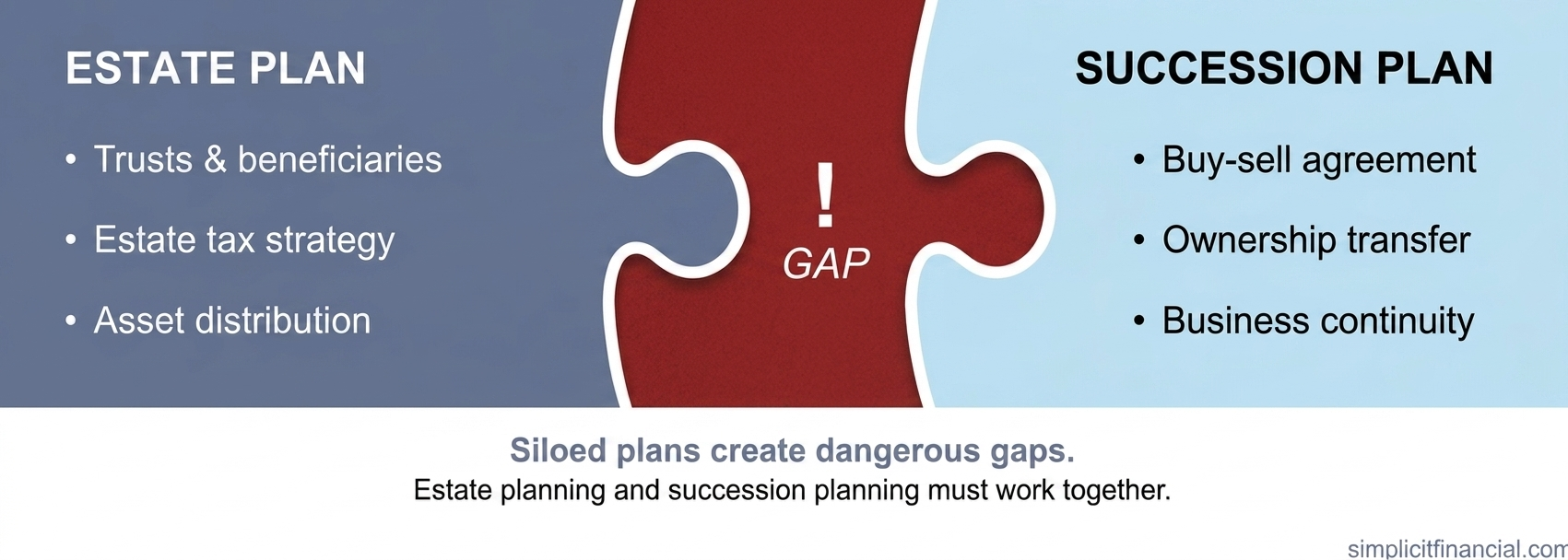
For many private business owners, the company isn't just a source of income — it's the cornerstone of their family's financial future. Yet despite the stakes, a remarkably common mistake continues to quietly erode that future: treating estate planning and succession planning as two separate conversations.
They're not. And when they're siloed, the consequences can be devastating.
The Two-Plan Problem
Consider what typically happens. A business owner works with an estate attorney to minimize estate taxes and ensure assets pass to heirs efficiently. At some point, perhaps with a different advisor, they also create a succession plan — a document or agreement that outlines who takes over the business and under what conditions.
Both plans exist. Both look fine on paper. But they were built in isolation, by different professionals, without each knowing what the other was doing. The estate plan doesn't account for the illiquid nature of the business interest. The succession plan doesn't incorporate the estate tax consequences of a buyout. And in the event of the owner's death or disability, those two documents collide — often creating a liquidity crisis, family conflict, and forced business decisions at exactly the wrong moment.
"A succession plan that ignores estate taxes creates a liquidity crisis at the worst possible moment. An estate plan that ignores business ownership creates chaos for the people left behind."
What's Actually at Stake
Here's a straightforward illustration of how the gap manifests. A business owner has a $10 million estate, with $7 million of that value tied up in the business. The estate plan calls for assets to pass to children equally. The succession plan calls for a key employee to buy out the owner's share over time.
The problem: the estate taxes due at death are calculated on the full $10 million estate — but the children inherit an interest that's difficult to value, hard to sell, and subject to a buyout that may not generate immediate cash. The estate tax bill arrives before the business transition is complete. The family scrambles to fund it.
This isn't an unusual scenario. It's a common one. And it's entirely preventable with integrated planning.
What Integration Actually Looks Like
A properly integrated estate and succession plan starts with a coordinated team — estate attorney, CPA, financial advisor, and a life insurance specialist who understands how to bridge the gap between the two plans.
Key elements of a unified approach include:
• A clear, funded mechanism for transitioning business ownership — whether to a family member, key employee, or third-party buyer
• Life insurance structures designed to provide liquidity for estate taxes, buyout obligations, and family income needs simultaneously
• Trust structures (such as irrevocable trusts or ILITs) that remove insurance proceeds from the taxable estate while keeping them available to fund the plan
• Buy-sell agreements that are properly drafted, regularly reviewed, and legally aligned with current tax law — including post-Connelly requirements
• Regular coordination across all advisors, so that a change in one plan triggers a review of the other
The Role of Life Insurance in Bridging the Gap
This is where many business owners — and their advisors — leave real value on the table. Properly structured life insurance doesn't just provide a death benefit. It is a precision tool for funding the obligations that arise when a business transitions.
It can fund an estate tax liability that would otherwise force a fire sale of the business. It can provide the surviving business partners with the capital to execute a buyout without disrupting operations. It can create a source of income for a spouse or non-active heirs who have no role in the business but depend on its value for their financial security.
At Simplicit Financial, we specialize in designing life insurance strategies that are fully integrated with our clients' estate and succession plans. We have no carrier bias and no AUM participation — which means our recommendations are always driven by what's right for the plan, not what's right for a carrier or an investment portfolio.
Ready to see what an integrated plan could look like for your business? Contact Simplicit Financial to schedule a strategy conversation.